
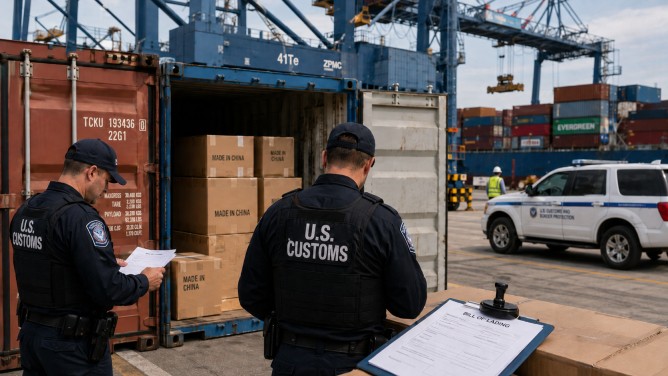
The United States has identified a network involving 38 countries and the European Union, accusing them of enabling Chinese goods subjected to high U.S. tariffs to reach the American market via third-party nations. This network, dubbed a “shadow transshipment network,” is detailed in a report titled “The Great Transshipment Scam,” which suggests that this potentially illicit rerouting could be valued at approximately $60 billion. The report claims that the U.S. has faced significant tariff revenue losses due to these activities.
Among the countries and territories implicated are India, Canada, the European Union, Israel, Japan, Mexico, South Korea, Taiwan, Brazil, Indonesia, Malaysia, Thailand, Turkey, Vietnam, Argentina, Azerbaijan, Bangladesh, Cambodia, Chile, Colombia, Costa Rica, the Dominican Republic, Georgia, Jordan, Kazakhstan, Kenya, Laos, Morocco, Myanmar, Oman, Panama, Peru, the Philippines, Singapore, Sri Lanka, Switzerland, the UAE, and Uzbekistan. These regions are alleged to partake in facilitating the movement of goods that escape the intended tariff barriers set by the U.S.
The report further elaborates on the extent of the transshipping activities, estimating that in 2025, around $67 billion worth of goods destined for the U.S. were rerouted from China through key transshipment hubs such as Mexico, India, and Vietnam. This diversion is believed to have contributed to an estimated $28 billion loss in U.S. tariff revenues, as goods circumvented the direct import routes that would have subjected them to higher tariffs.
Particularly noteworthy is the mention of the Pune-Gujarat-Chennai corridor in India, where Chinese shipments, including products like electric pumps and compressors, have reportedly bolstered local businesses. This development has, however, intensified competitive pressures on American manufacturers, suggesting a dual impact of economic benefit overseas and industrial strain at home.
In response to these revelations, the U.S. is contemplating a series of measures aimed at curbing these practices. Proposed actions include implementing stricter inspections and interdiction protocols, imposing additional tariffs, enforcing sanctions, and possibly restricting market access for those countries that continue to support tariff evasion. These steps aim to protect U.S. economic interests and ensure fairness in trade practices.