
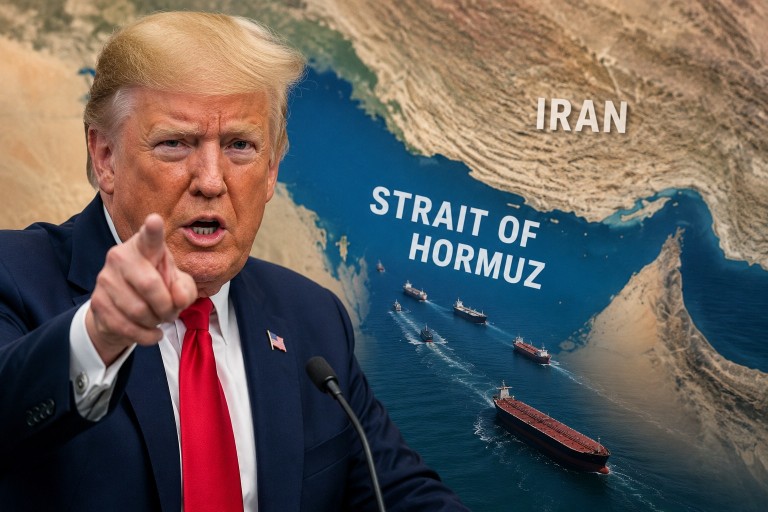
In a bold statement, U.S. President Donald Trump has signaled an intention to assert control over the Strait of Hormuz, labeling it potentially as “a territory of the United States.” This announcement comes amid ongoing tensions as Washington seeks a resolution to the conflict with Iran. Speaking at an event in New York, Trump suggested that this declaration could come “pretty soon” following a victory over Iran, and claimed that the U.S. currently exercises control over the vital waterway through a blockade.
The Strait of Hormuz holds significant strategic importance as it serves as a conduit for about 20% of the world’s seaborne oil supply. Geographically, it lies nestled between Iran and Oman and has largely remained inaccessible since U.S. and Israeli military operations commenced against Iran. Despite Trump’s statements, there remains ambiguity regarding whether these remarks reflect an official shift in U.S. policy or are merely rhetorical.
Reacting to Trump’s assertions, Iran has firmly rejected the notion of U.S. control. Kazem Gharibabadi, Iran’s Deputy Foreign Minister, emphasized that the U.S. pressure tactics would not intimidate Tehran and reaffirmed that decisions regarding the strait’s operations rest solely with Iran. Furthermore, Iranian Foreign Minister Abbas Araqchi clarified that while messages are being exchanged via Qatar and Pakistan, they do not amount to formal negotiations with the U.S.
Iran has set forth several conditions before considering the reopening of the strait to international shipping. These include demands for compensation for war-related damages, the lifting of economic sanctions, and the release of Iranian assets currently frozen abroad. Meanwhile, the conflict’s impact on shipping routes has contributed to rising fuel prices, affecting consumers worldwide. President Trump justified the increased prices, asserting that the financial burden is necessary to prevent Iran from developing nuclear weapons.
The ongoing deadlock over the Strait of Hormuz has sparked concerns over the stability of global energy supplies and the broader economic repercussions of the conflict. As tensions continue, stakeholders around the world are closely monitoring the situation, wary of its potential to further disrupt international markets.