
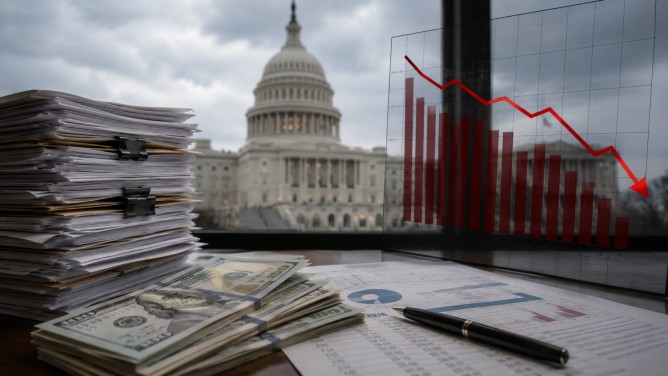
The United States federal budget deficit is on track to reach approximately $2.1 trillion by fiscal year 2026, driven by government spending outpacing tax revenue, as projected by the Congressional Budget Office. In the first 10 months of the current fiscal year, the federal government has already logged a deficit close to $1.8 trillion, marking an increase of about $169 billion compared to the same timeframe last year. During this period, federal expenditures surged by $308 billion, while tax receipts experienced a more modest rise of $139 billion.
A significant factor contributing to the expanding deficit is the rising interest costs on the national debt, with interest payments jumping by $117 billion, or 14%, in the first 10 months compared to the previous year. Additionally, expenditures on major government programs have seen notable increases. Social Security costs rose by $70 billion, Medicare by $66 billion, and Medicaid by $45 billion, further impacting the federal budget.
Despite a rise in individual and payroll tax collections, there has been a marked decline in corporate tax revenue. The government’s overall income has also been constrained by tariff revenue, which has been affected by refunds. These dynamics have contributed to the ongoing fiscal challenges the government faces in balancing its budget.
While government spending is expected to remain in line with earlier forecasts, the Congressional Budget Office now predicts revenue to fall short by about $200 billion compared to previous estimates. This growing deficit is raising alarms about the sustainability of U.S. government borrowing and the implications of the nation’s rising national debt.