
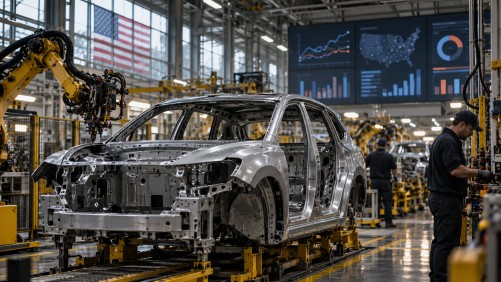
Uncertainty about U.S. electric vehicle (EV) policies is posing significant challenges for automakers, casting doubts on investment and production strategies, and raising concerns about the competitiveness of the American automotive industry. Recent protectionist measures, such as tariffs over 100% on Chinese EVs and restrictions on China-linked automotive software and hardware, are at the heart of these concerns.
While these tariffs and restrictions are in place to address trade and data security issues, analysts argue that without a consistent long-term industrial strategy, these measures may not effectively bolster domestic manufacturers. The policy landscape has been further complicated by changes in government incentives and fuel economy standards during President Donald Trump’s administration, which have introduced additional uncertainties for automakers planning long-term investments.
This policy ambiguity has led some U.S. companies to reconsider their expansion plans, delay the rollout of new EV platforms, or adjust production targets. Meanwhile, Chinese manufacturers, such as BYD, are hesitant to enter the U.S. market under these uncertain conditions. Nevertheless, the U.S. remains an attractive market for affordable EVs due to Chinese advancements in battery technology and cost-efficient production capabilities.
Despite the current restrictions, there are potential opportunities for cooperation that could emerge from future U.S.-China trade negotiations. President Trump has suggested that Chinese automakers might be allowed to manufacture vehicles in the U.S. if they build factories and create local jobs. However, American automotive industry groups have urged the administration to maintain restrictions on Chinese manufacturers.
Some U.S. companies are already exploring selective partnerships with Chinese firms. Ford, for example, is collaborating with Chinese battery manufacturer CATL on a facility in Michigan, where CATL contributes its technology and related services. Such partnerships indicate that while broad restrictions on Chinese automakers are likely to persist, there may still be room for cooperation in battery technology and manufacturing where there are clear commercial benefits.